

By Helen Udo.
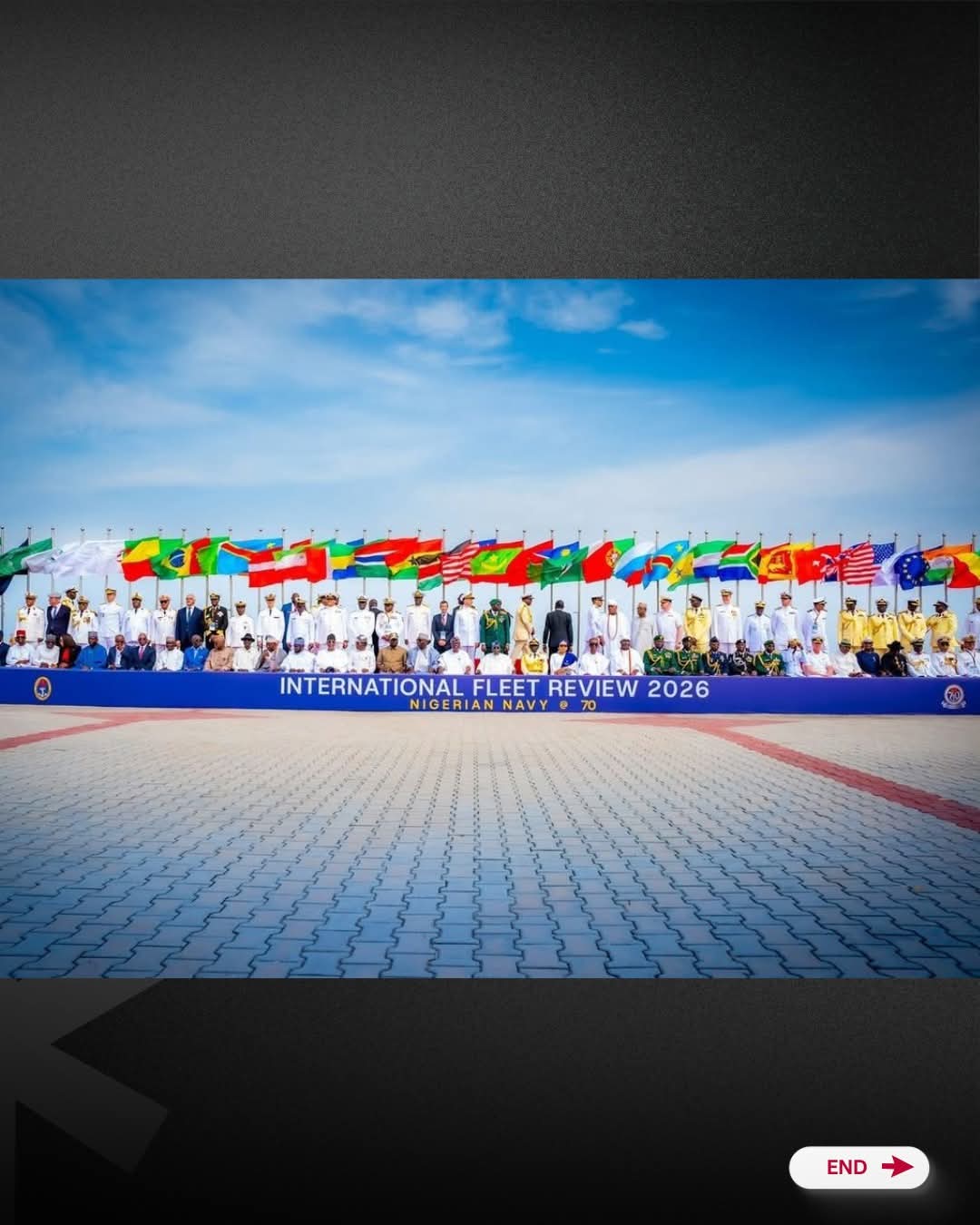
The Nigerian Navy marked a historic milestone on 1 June 2026 as it celebrated its 70th Anniversary with an impressive International Fleet Review at the Eko Atlantic Waterfront, Lagos, where President Bola Ahmed Tinubu commissioned three new naval vessels and reaffirmed his administration’s commitment to strengthening Nigeria’s maritime security architecture.
The landmark event brought together naval chiefs, military leaders, government officials and representatives of friendly foreign navies, underscoring Nigeria’s growing influence in maritime affairs and regional security cooperation, also provided an opportunity to reflect on the Navy’s seven-decade journey from a modest colonial marine department established in 1956 to what President Tinubu described as Africa’s most formidable naval force.
In his keynote address, the President praised the Nigerian Navy for its remarkable transformation and operational achievements, noting that the service has evolved into a modern and sophisticated force that serves as a critical pillar of Nigeria’s economic prosperity and national security. According to him, the coincidence of the Navy’s emergence as a continental leader with its 70th anniversary symbolizes the maturity and strategic relevance it has attained over the years.
President Tinubu emphasized that Nigeria’s maritime domain remains one of the nation’s most valuable economic assets, serving as a major source of foreign exchange and a critical gateway for international trade.
He commended the Navy’s relentless efforts in safeguarding the nation’s waters through advanced surveillance systems, rapid response capabilities and sustained enforcement operations.
These efforts, he noted, have yielded significant results, including the eradication of piracy in Nigerian waters and the substantial reduction of crude oil theft and other maritime crimes. Beyond securing the nation’s coastline, the President observed that these achievements have contributed to increased oil production, improved investor confidence and enhanced economic growth.
The President also highlighted the Navy’s growing role in addressing broader national security challenges. He commended the Special Boat Service for its professionalism and courage in executing complex operations and expressed optimism that the recent induction of Nigerian Navy Marines into operational theatres would further strengthen ongoing counterterrorism and counterinsurgency efforts across the country.
A major highlight of the ceremony was the inauguration of the Combined Maritime Task Force, an initiative designed to strengthen multinational maritime security cooperation in the Gulf of Guinea. President Tinubu described the initiative as a demonstration of collective determination among regional partners to secure shared waters against emerging threats.
He specifically acknowledged the contributions of Côte d’Ivoire, The Gambia, Ghana, Liberia and Sierra Leone for their pioneering roles in bringing the initiative to life.
The President further demonstrated his administration’s commitment to naval modernization by commissioning three newly acquired vessels, describing the development as another important step in the ongoing recapitalisation of the Navy.
He reiterated the Federal Government’s support for indigenous shipbuilding and other strategic initiatives aimed at enhancing the Navy’s operational readiness and effectiveness.
Earlier in his welcome remarks, the Chief of the Naval Staff, Vice Admiral Ilyasu Abbas, described the International Fleet Review as more than a ceremonial event, noting that it represented the enduring partnership between government, the Nigerian Navy and international allies in advancing maritime security and stability.
The Naval Chief commended President Tinubu for his unwavering support towards the development of the Navy, stressing that the administration’s investments have significantly enhanced the service’s capabilities.
He noted that the presence of foreign naval delegations at the event reflected the strength of Nigeria’s maritime partnerships and the shared commitment to maintaining a piracy-free Gulf of Guinea.
According to Vice Admiral Abbas, one of the most significant outcomes of these collaborative efforts is the establishment of the Combined Maritime Task Force, which will serve as a standing force capable of responding to maritime threats, supporting humanitarian missions and contributing to peacekeeping efforts across the West African sub-region.
Beyond fleet expansion, the Naval Chief disclosed that the Navy is embracing emerging technologies to improve Maritime Domain Awareness.
The integration of Unmanned Aerial Vehicles and Artificial Intelligence into naval operations, he explained, has significantly improved the service’s ability to monitor maritime activities, detect threats and combat crude oil theft, illegal bunkering and smuggling.
Recognizing that technology alone cannot guarantee security, Vice Admiral Abbas emphasized the importance of human capacity development.
He highlighted the recent training and induction of the first batch of 328 Nigerian Navy Marines, describing the elite force as a major enhancement to the Navy’s operational capability in maritime security, counterterrorism and inland security operations.
As the Nigerian Navy celebrates seven decades of operational excellence, both President Tinubu and the Chief of the Naval Staff projected a future defined by modernization, innovation and stronger international cooperation. Their speeches reflected a shared vision of a Navy that not only protects Nigeria’s maritime interests but also contributes significantly to regional stability, economic growth and global maritime security.
With new vessels joining the fleet, advanced technologies being integrated into operations and strategic partnerships expanding across the Gulf of Guinea, the Nigerian Navy appears poised to enter its next decade stronger, more capable and better positioned to meet the evolving security challenges of the maritime domain.
The 70th anniversary celebration therefore served not only as a reflection on past achievements but also as a declaration of readiness for the future.