


By Helen Udo.
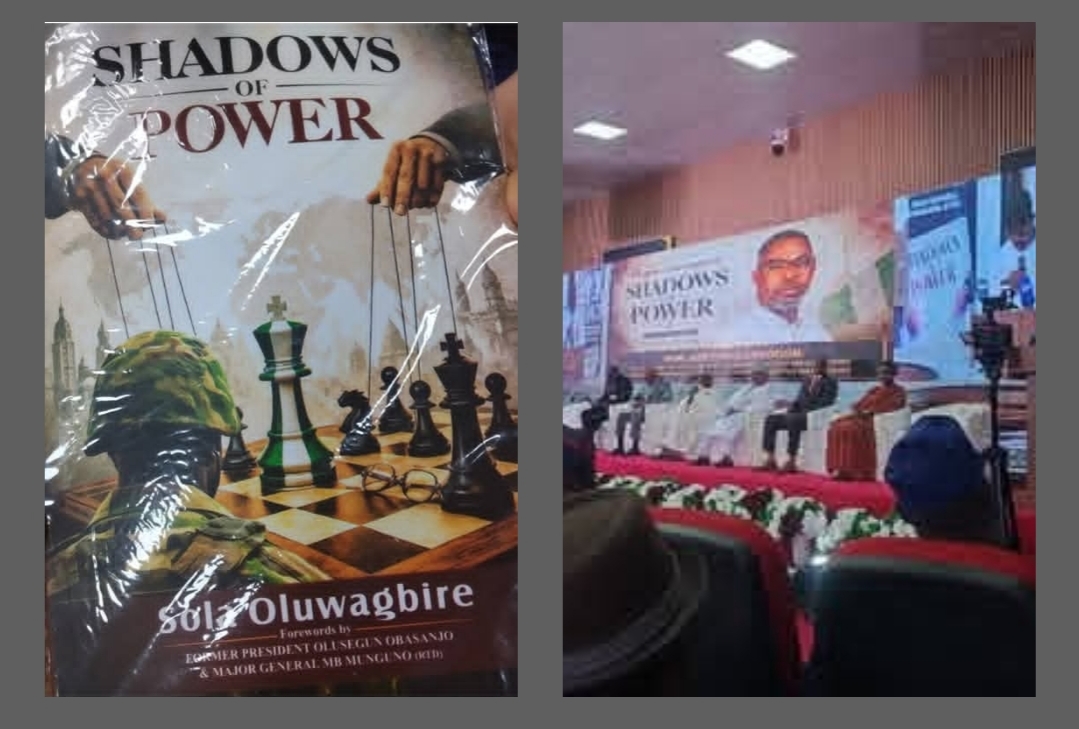
Nigeria’s foreign policy, national security and strategic future took centre stage as Shadows of Power, a new book authored by retired Rear Admiral Olusola Kolawole Oluwagbire, was officially launched at the Nigerian Army Conference Centre and Suites, Abuja, on June 25, 2026.
The event attracted an array of distinguished military officers, diplomats, policymakers, academics and government officials. It was chaired by former President Chief Olusegun Obasanjo, GCFR, while the Honourable Minister of Defence, General Christopher Gwabin Musa (Rtd), OFR, attended as the Special Guest of Honour.
The keynote presentation was delivered by the Minister of State for Foreign Affairs, Ambassador Sola Enikanolaiye, who described the publication as a timely contribution to the national conversation on security, diplomacy and Nigeria’s place in an increasingly competitive global order.
Drawing from his decades of military service and diplomatic experience, Rear Admiral Oluwagbire examines how the strategic interests of major global powers continue to shape Nigeria’s national security and foreign policy.
The book argues that beyond military threats, Nigeria must strengthen its institutions, rebuild industrial capacity, promote self reliance and align its defence architecture with foreign policy objectives in order to safeguard its sovereignty and national interests.
Delivering his address, Ambassador Enikanolaiye said the Federal Government has repositioned Nigeria’s foreign policy by placing Nigerians and the country’s national interest at the centre of every diplomatic engagement.
According to him, every foreign policy decision must directly advance Nigeria’s security, defence and economic prosperity.
He explained that the administration has reordered the traditional pillars of Nigeria’s foreign policy by placing Demography the Nigerian people as the first priority, followed by Development, Democracy and the Diaspora. While reaffirming the importance of democracy, he stressed that democratic governance must ultimately deliver tangible benefits to citizens through improved security, economic opportunities and human development.
The Minister noted that Nigeria’s immediate neighbours remain the country’s first line of diplomatic engagement, stressing that peace, stability and prosperity in neighbouring countries are directly linked to Nigeria’s own security.
He explained that instability across the Sahel region has demonstrated the need for stronger regional cooperation and renewed diplomatic engagement.
Ambassador Enikanolaiye further maintained that Nigeria must first build a strong domestic foundation before seeking to reclaim its traditional leadership role in Africa.
According to him, President Bola Ahmed Tinubu’s economic and governance reforms are designed to strengthen the country’s internal resilience, national unity and economic capacity, thereby providing the platform for a more effective and influential foreign policy.
On strategic autonomy, he said Nigeria’s policy of non-alignment simply means remaining firmly aligned with its national interest rather than any global power bloc.
He affirmed that while Nigeria has deepened engagements with the United States and the United Kingdom, the country continues to maintain productive partnerships with China, Russia, Turkey, Saudi Arabia, Brazil and other strategic partners based solely on Nigeria’s developmental and security priorities.
The Minister also highlighted ongoing reforms within the Ministry of Foreign Affairs aimed at restoring professionalism and institutional efficiency.
These include improved record management systems, compulsory professional training, merit-based promotions and transparent overseas postings.
He emphasised that diplomacy and defence must work together as complementary instruments of national policy to secure Nigeria’s future.
Commending the author, Ambassador Enikanolaiye described Shadows of Power as a timely wake up call for policymakers and citizens alike, urging Nigerians to remain focused on advancing the country’s strategic autonomy and long-term national interests.
He acknowledged that although Nigeria’s international visibility may have diminished in recent years, the country remains firmly on course to reclaiming its influence through sustained reforms and strategic partnerships.
Speaking with journalists after the launch, Rear Admiral Oluwagbire explained that the inspiration for the book came from years of research into how major world powers influence Nigeria’s national security through diplomatic, economic and military relationships.
According to him, the publication seeks to encourage critical thinking about Nigeria’s external engagements while promoting informed public discourse on foreign policy and national security.
He described the book as the beginning of a broader intellectual effort to stimulate national consciousness about Nigeria’s strategic future.
“This book is only a step in that direction. It is one block in building national consciousness and encouraging informed discussions. Every nation pursues its own interests, and Nigeria must equally develop the capacity to protect its own national interest while strengthening its position as a regional leader and an influential actor on the global stage,” he said.
Rear Admiral Oluwagbire expressed confidence that Nigeria possesses the resources, strategic potential and human capacity to emerge as a stronger regional power, provided its policies consistently reflect its national interests and long-term developmental aspirations.
The launch of Shadows of Power concluded with renewed calls for stronger synergy between diplomacy, defence and national development, as participants agreed that Nigeria’s future influence in Africa and the wider international community will depend largely on the country’s ability to build resilient institutions, pursue pragmatic foreign policies and place national interest above all else.